
Eukaryotic Immunoglobulin Kappa (Igk)
IGKC; HCAK1; Km; Immunoglobulin Kappa Constant; IgA Kappa
- Product No.UEPD038Mu61
- Organism SpeciesMus musculus (Mouse) Same name, Different species.
- SourceEukaryotic expression
- Host293F cell
- Endotoxin Level<1.0EU per 1µg (determined by the LAL method)
- Subcellular LocationMembrane
- Predicted Molecular Mass13.5kDa
- Accurate Molecular Mass14kDa(Analysis of differences refer to the manual)
- Residues & TagsArg1~Cys107 with N-terminal His Tag
- Buffer FormulationPBS, pH7.4, containing 5% Trehalose.
- TraitsFreeze-dried powder
- Purity> 90%
- Isoelectric Point5.7
-
Applications
Positive Control; Immunogen; SDS-PAGE; WB.
If bio-activity of the protein is needed, please check active protein. - Download Instruction Manual
- UOM 10µg50µg 200µg 1mg 5mg
-
FOB
US$ 134
For more details, please contact local distributors!US$ 335
For more details, please contact local distributors! US$ 670
For more details, please contact local distributors! US$ 2010
For more details, please contact local distributors! US$ 5025
For more details, please contact local distributors!
-
 Packages (Simulation)
-
 Packages (Simulation)
-
 Figure. SDS-PAGE
-
ISO9001: 2008, ISO13485: 2003 Registered
SEQUENCE of the Eukaryotic Immunoglobulin Kappa (Igk)
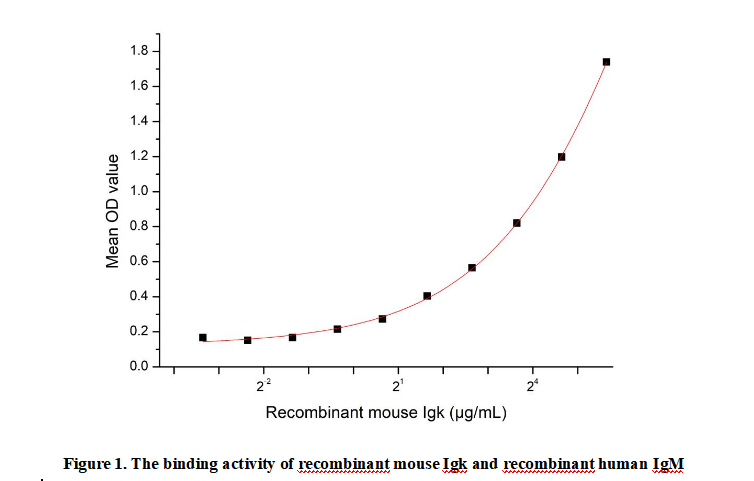
Immunoglobulin Kappa (Igk) is a type of light chain found in antibodies, which are critical components of the adaptive immune system . It associates with immunoglobulin heavy chains to constitute complete, functional antibody molecules, including but not limited to IgG and IgM classes. This pairing is essential for the structural integrity and antigen-binding capability of these immunoglobulins. In humans, the IGK gene located on chromosome 2 encodes this essential protein, which represents one of the two major light chain types - either kappa or lambda. The production of Igk chains is subject to stringent regulatory mechanisms to guarantee correct antibody formation. Impairments in Igk function may result in various immunological disorders, including immunodeficiency states and B-cell derived cancers. Clinically, kappa light chains have significant diagnostic value as biomarkers for detecting monoclonal gammopathies, particularly multiple myeloma.To detect the activity of recombinant Igk, a functional ELISA assay was performed to evaluate the interaction between recombinant mouse Igk and recombinant human IgM.Briefly, Igk was diluted serially in PBS with 0.01% BSA (pH 7.4). Duplicate samples of 100 μl were then transferred to IgM-coated microtiter wells and incubated for 1h at 37℃. Wells were washed with PBST and incubated for 1h with anti-Igk pAb, then aspirated and washed 3 times. After incubation with HRP labelled secondary antibody for 1h at 37℃, wells were aspirated and washed 5 times. With the addition of substrate solution, wells were incubated 15-25 minutes at 37℃. Finally, add 50 µL stop solution to the wells and read at 450/630nm immediately. The binding activity of recombinant mouse Igk and recombinant human IgM was shown in Figure 1, and this effect was in a dose dependent manner.
USAGE of the Eukaryotic Immunoglobulin Kappa (Igk)
Reconstitute in 10mM PBS (pH7.4) to a concentration of 0.1-1.0 mg/mL. Do not vortex.
STORAGE of the Eukaryotic Immunoglobulin Kappa (Igk)
Avoid repeated freeze/thaw cycles. Store at 2-8°C for one month. Aliquot and store at -80°C for 12 months.
STABILITY of the Eukaryotic Immunoglobulin Kappa (Igk)
The thermal stability is described by the loss rate. The loss rate was determined by accelerated thermal degradation test, that is, incubate the protein at 37°C for 48h, and no obvious degradation and precipitation were observed. The loss rate is less than 5% within the expiration date under appropriate storage condition.
INCREMENT SERVICES
BCA Protein Quantification Kit
Protein Labeling Customized Service
Molecular Mass Marker for Protein
Monoclonal Antibody Customized Service
Polyclonal Antibody Customized Service
Protein Activity Test Experiment Service
Immunoprecipitation (IP) Experiment Service
Electrophoretic Mobility Shift Assay (EMSA) Experiment Service
Buffer
Lentivirus Packaging Experiment Service
Adenovirus Packaging Experiment Service
Real Time PCR Experimental Service
Spike RBD Protein (S-RBD)
Protein G
Protein A