
Active Osteopontin (OPN)
SPP1; BNSP; BSPI; ETA1; Secreted Phosphoprotein 1; Bone Sialoprotein I; Early T-Lymphocyte Activation 1; Nephropontin; Urinary stone protein; Uropontin
- Product No.UAPA899Bo61
- Organism SpeciesBos taurus; Bovine (Cattle) Same name, Different species.
- Buffer FormulationPBS, pH7.4, containing 5% Trehalose.
- TraitsFreeze-dried powder
- Purity> 80%
- Isoelectric Point4.2
- ApplicationsCell culture; Activity Assays.
- Download Instruction Manual
- UOM 10µg50µg 200µg 1mg 5mg
-
FOB
US$ 144
For more details, please contact local distributors!US$ 360
For more details, please contact local distributors! US$ 720
For more details, please contact local distributors! US$ 2160
For more details, please contact local distributors! US$ 5400
For more details, please contact local distributors!
-
 Packages (Simulation)
-
 Packages (Simulation)
-
 Figure. SDS-PAGE
-
ISO9001: 2008, ISO13485: 2003 Registered
ACTIVITY TEST of the Active Osteopontin (OPN)
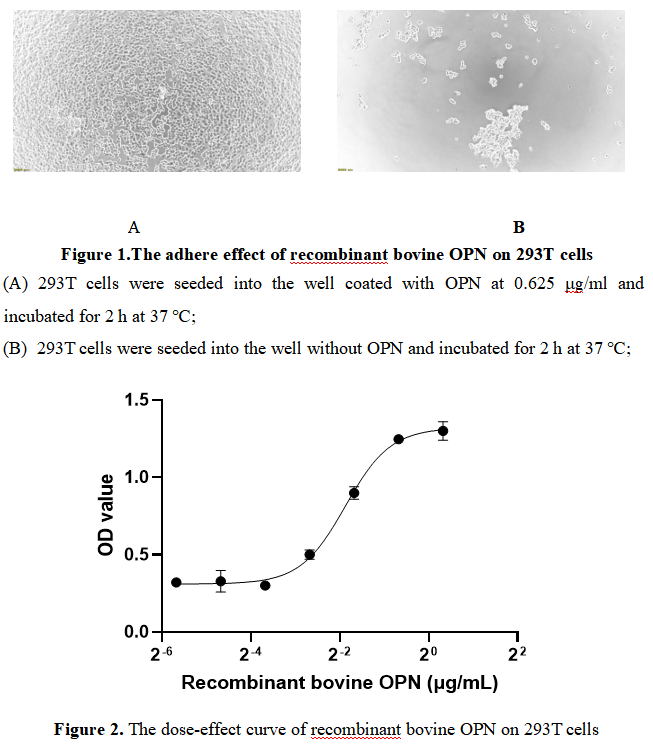
Osteopontin (OPN), also known as secreted phosphoprotein 1 (SPP1), is a highly conserved, multifunctional glycoprotein that plays pivotal roles in various physiological and pathological processes. Encoded by the SPP1 gene, this protein is characterized by its arginine-glycine-aspartic acid (RGD) motif, which enables it to interact with integrin receptors, facilitating cell adhesion, migration, and signaling. As OPN has the function of cell adhesion, we measure the activity of recombinant bovine OPN by the ability of the immobilized protein to support the adhesion of 293T cells. When cells are added to different concentrations of recombinant bovine OPN coated plates, cells will adhere after 2 hour incubation at 37 ℃. The adhesion of 293T after 2 hour incubation at 37 ℃ observed by inverted microscope was shown in Figure 1. Cells adherent was in a dose dependent manner, the result was shown in Figure 2, the EC50 was 0.27 μg/ml.
USAGE of the Active Osteopontin (OPN)
Reconstitute in 10mM PBS (pH7.4) to a concentration of 0.1-1.0 mg/mL. Do not vortex.
STORAGE of the Active Osteopontin (OPN)
Avoid repeated freeze/thaw cycles. Store at 2-8°C for one month. Aliquot and store at -80°C for 12 months.
STABILITY of the Active Osteopontin (OPN)
The thermal stability is described by the loss rate. The loss rate was determined by accelerated thermal degradation test, that is, incubate the protein at 37°C for 48h, and no obvious degradation and precipitation were observed. The loss rate is less than 5% within the expiration date under appropriate storage condition.
INCREMENT SERVICES
BCA Protein Quantification Kit
Molecular Mass Marker for Protein
Monoclonal Antibody Customized Service
Polyclonal Antibody Customized Service
Protein Activity Test Experiment Service
Electrophoretic Mobility Shift Assay (EMSA) Experiment Service
Buffer
Lentivirus Packaging Experiment Service
Adenovirus Packaging Experiment Service
Real Time PCR Experimental Service
Spike RBD Protein (S-RBD)
Protein G
Protein A
Related products
| Catalog No. | Organism species: Bos taurus; Bovine (Cattle) | Applications (RESEARCH USE ONLY!) |
| UAPA899Bo61 | Active Osteopontin (OPN) | Cell culture; Activity Assays. |
| UEPA899Bo61 | Eukaryotic Osteopontin (OPN) | Positive Control; Immunogen; SDS-PAGE; WB. |
| URPA899Bo01 | Recombinant Osteopontin (OPN) | Positive Control; Immunogen; SDS-PAGE; WB. |
| UPAA899Bo01 | Polyclonal Antibody to Osteopontin (OPN) | IHC |
| UMAA899Bo21 | Monoclonal Antibody to Osteopontin (OPN) | WB |
| USEA899Bo | ELISA Kit for Osteopontin (OPN) | Enzyme-linked immunosorbent assay for Antigen Detection. |
| ULMA899Bo | Multiplex Assay Kit for Osteopontin (OPN) ,etc. by FLIA (Flow Luminescence Immunoassay) | FLIA Kit for Antigen Detection. |